Lease Accounting — ASC 842 vs IFRS 16
2026-08-21
Notes on lease accounting
This curriculum is organized into 10 steps, from identifying a lease all the way to where the two standards genuinely diverge. Every step is really the same underlying question asked from a different angle: who controls what, and how does that translate into a number.
Step 1
Lease Identification
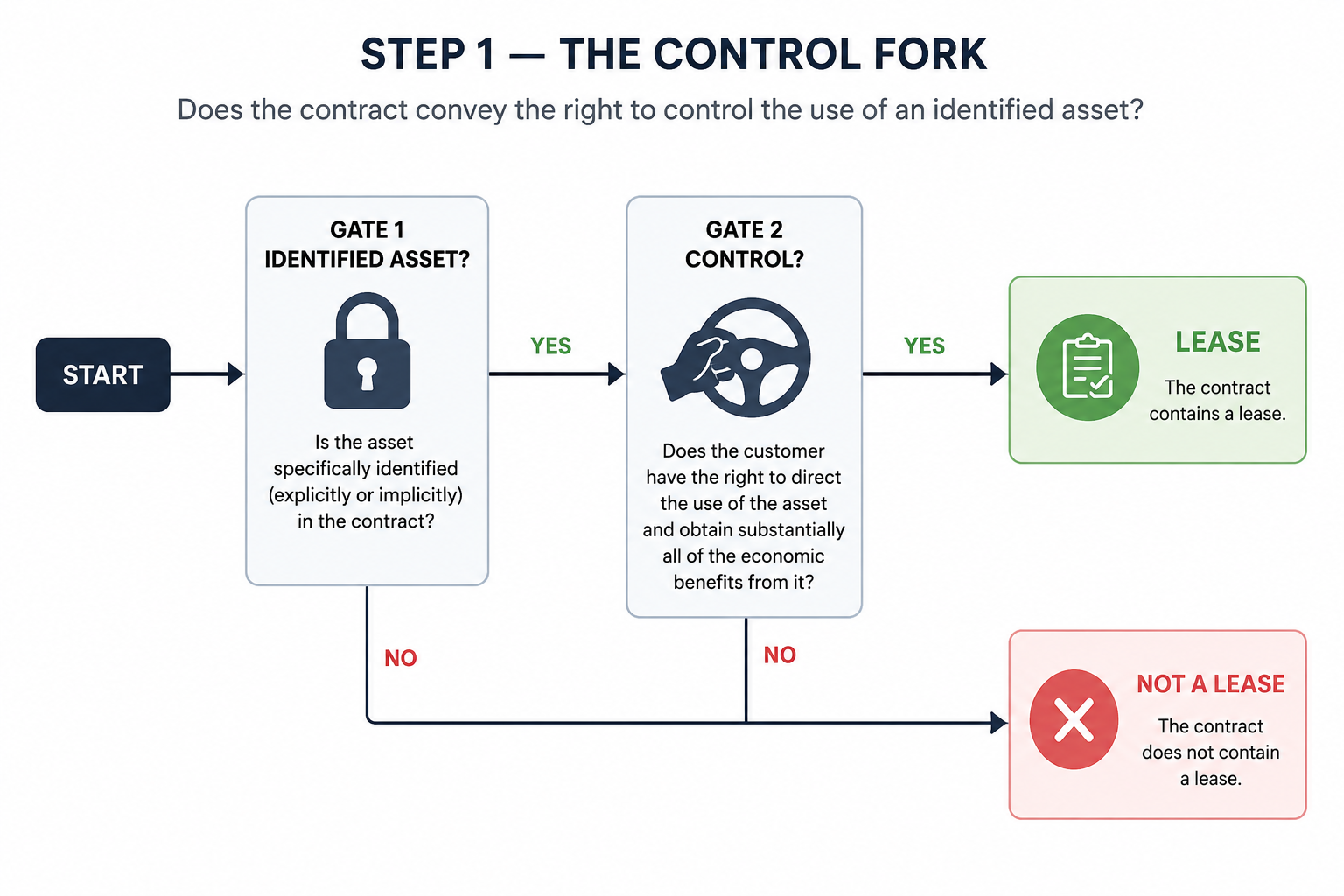
A contract is a lease only when two conditions hold together:
- Identified asset, a specific, fixed asset that cannot be swapped out.
- Control, the right to decide how, when, and for what purpose the asset is used.
Both are required. If either is missing, it isn't a lease.
When the identified-asset test fails: when the supplier holds a substantive substitution right, practically able to swap the asset, AND the supplier benefits from doing so. A right reserved only for breakdowns or servicing (a protective right) does not defeat this test, it's a safety net, not a real choice.
⚠️ Common mistake
Treating a clause like "the landlord can move you to a different spot whenever convenient" as a control issue. It's actually an identified asset issue, the asset itself is no longer fixed, so the control question never even arises.
When control exists: ownership is irrelevant, control is about who makes the day-to-day decisions on use. A boundary condition (such as "only during gym hours" or "retail use only") does not take away control, it's a one-time condition set at the outset. What matters is who decides, within that boundary, on a day-to-day basis (when, how, what).
⚠️ Common mistake
Assuming that any restriction at all means there's no "complete control," and therefore no lease. This is wrong, every lease in existence has some boundary condition (fire safety, building hours, permitted use). If "complete control" were the requirement, no lease anywhere would qualify as one.
Example, Parking Spot #7: A specific spot reserved for a full year, which the landlord cannot reassign; you park and retrieve your vehicle whenever you like. This is a lease, identified asset ✓, control ✓.
Example, Gym Locker #12: A fixed locker for the full year, no substitution clause. Access is limited to gym hours, and only gym clothing is permitted inside. These are boundary conditions, not control, what to store, and when to put it in or take it out, is your decision. This is a lease.
Step 2
Lease Liabilities
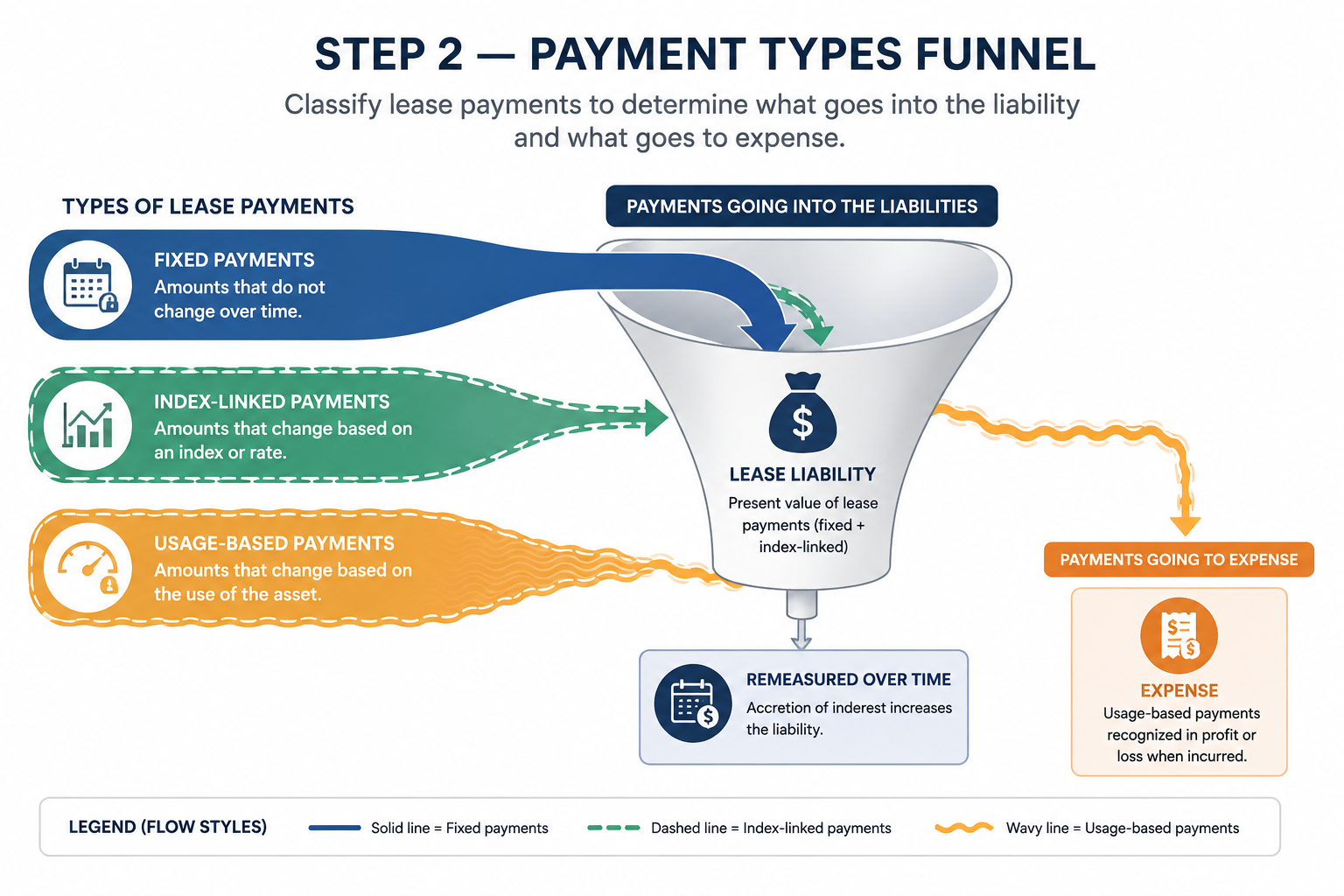
The liability equals the present value (PV) of the payments still owed, discounted at some rate. Future money is never worth as much as today's money, so PV is always less than the raw sum of the payments.
Not every payment goes into the liability. There are three types:
| Payment Type | Example | Included in Liability? |
|---|---|---|
| Fixed | ₹25,000/month, same every month | Yes, directly |
| Index/rate-linked variable | Rent that rises with an inflation index | Yes, frozen at the rate in effect at commencement |
| Usage/performance-linked variable | ₹5/km, or a percentage of sales | No, expensed only when the actual amount is known |
Why: Fixed and index-linked payments can be converted into a number today. A usage-based payment (how far the vehicle will be driven, how much revenue will be earned) simply isn't knowable today, so no PV can be calculated for it.
Guaranteed minimums (in-substance fixed): If a variable payment includes a guaranteed floor, for example, "₹5/km, but a minimum of ₹15,000/month regardless of whether the vehicle is driven at all", then up to the floor, it's treated as fixed and goes into the liability. Anything above the floor is the genuinely variable portion, expensed as incurred.
⚠️ Common mistake
Treating a payment with a guaranteed floor as entirely "variable," or entirely "fixed." The correct treatment is: fixed up to the floor, variable above it, both at once.
Worked Example: A vehicle lease, ₹25,000/month fixed + ₹5/km. If in a given month the usage bill comes to ₹22,000 (₹15,000 floor + ₹7,000 of extra usage), then ₹15,000 was already in the liability, and the remaining ₹7,000 is a pure expense for that month.
Step 3
Right-of-Use (ROU) Assets
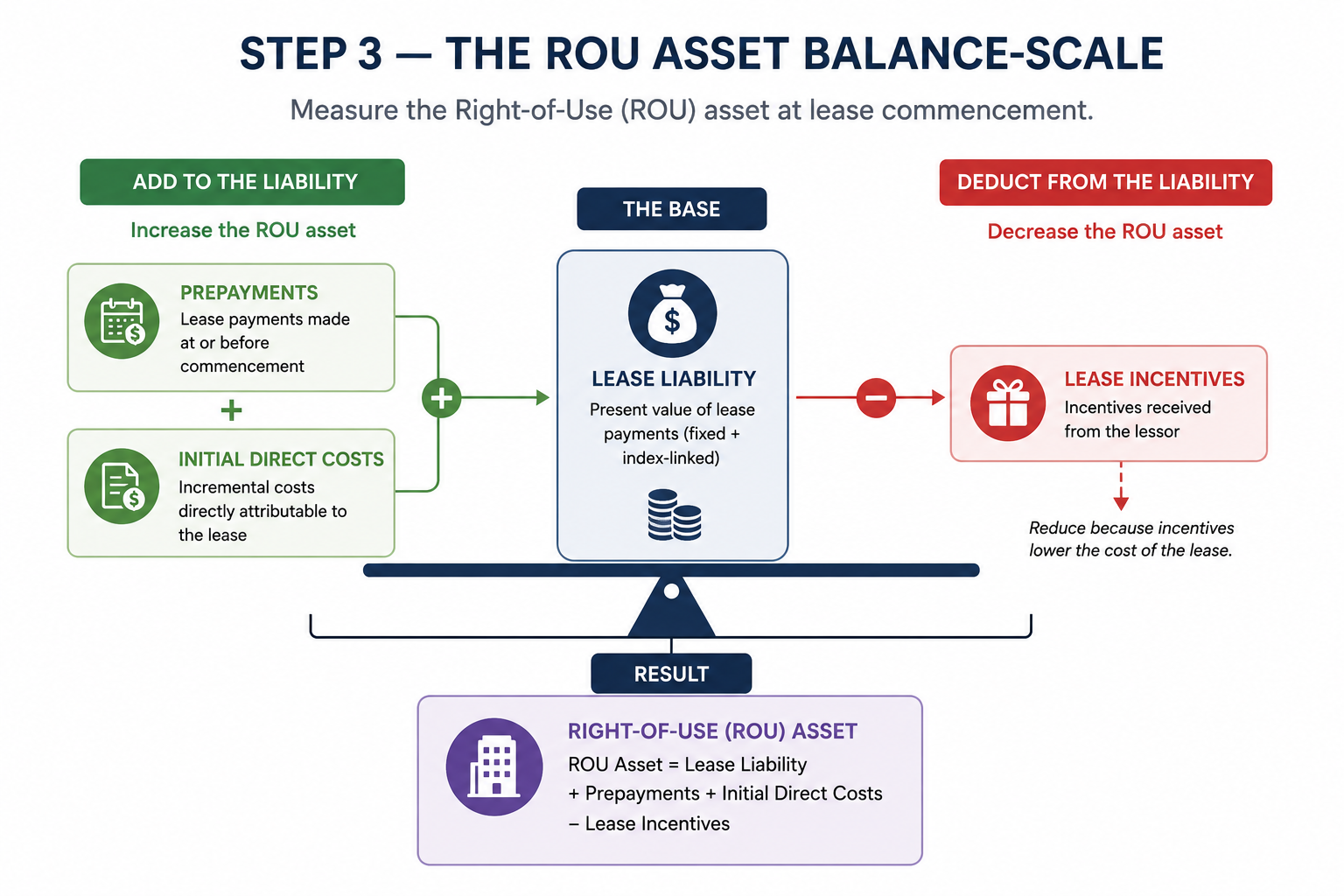
The ROU asset is built directly from the liability, then adjusted:
Formula: ROU Asset = Lease Liability + Prepayments (advance payments) + Initial Direct Costs (such as broker commission) − Incentives Received (such as landlord cash-back)
A simple way to remember it: Money paid out of your own pocket (or still owed) → ADD. Money you got back → SUBTRACT.
⚠️ Common mistake
Subtracting everything (treating the whole formula as "liability minus everything"), or mirroring the signs the wrong way round (adding the incentive, subtracting the costs). Test each item individually: "did I pay this, or did I receive it?"
Worked Example: Liability ₹10,00,000. Advance rent ₹40,000 (paid out of pocket → add). Registration fees ₹20,000 (paid out of pocket → add). A free servicing voucher worth ₹30,000, given by the leasing company as an incentive (received back → subtract).
ROU Asset = 10,00,000 + 40,000 + 20,000 − 30,000 = ₹10,30,000
Step 4
Discount Rate and Lease Term
Two discount rate options:
- Rate implicit in the lease, the lessor's own rate, built from their cost and residual value assumptions. This information is normally not available to the lessee.
- Incremental Borrowing Rate (IBR), the lessee's own rate: what a bank would charge if the lessee borrowed to buy the asset outright.
In practice, IBR is what's used in most cases.
Relationship to credit quality: Strong credit → lower IBR → higher PV (less discounting means future payments remain more valuable). Weak credit → higher IBR → lower PV.
This feels counter-intuitive: the same asset, the same payments, yet two companies can end up with different liability figures purely because their credit standing differs.
Lease term: Not simply the fixed contractual period, the real term runs for as long as the company is "reasonably certain" to remain in place. A renewal option is added to the term only when:
- Exiting or not renewing would be very costly, OR
- The renewal itself is highly favourable (for example, below-market rent).
Example, Favourable renewal: A 3+2 year office lease. The company is fully settled into that location (branding, employee commutes), and the renewal rent is set well below market. Renewal is reasonably certain → lease term = 5 years.
Example, Unfavourable renewal: Same structure, but the company has since gone remote-first and barely uses the office, and the renewal rent is set above market. There's no significant cost to walking away → lease term = 3 years (the fixed period only).
Step 5
Operating vs Finance Lease (Lessee Side)
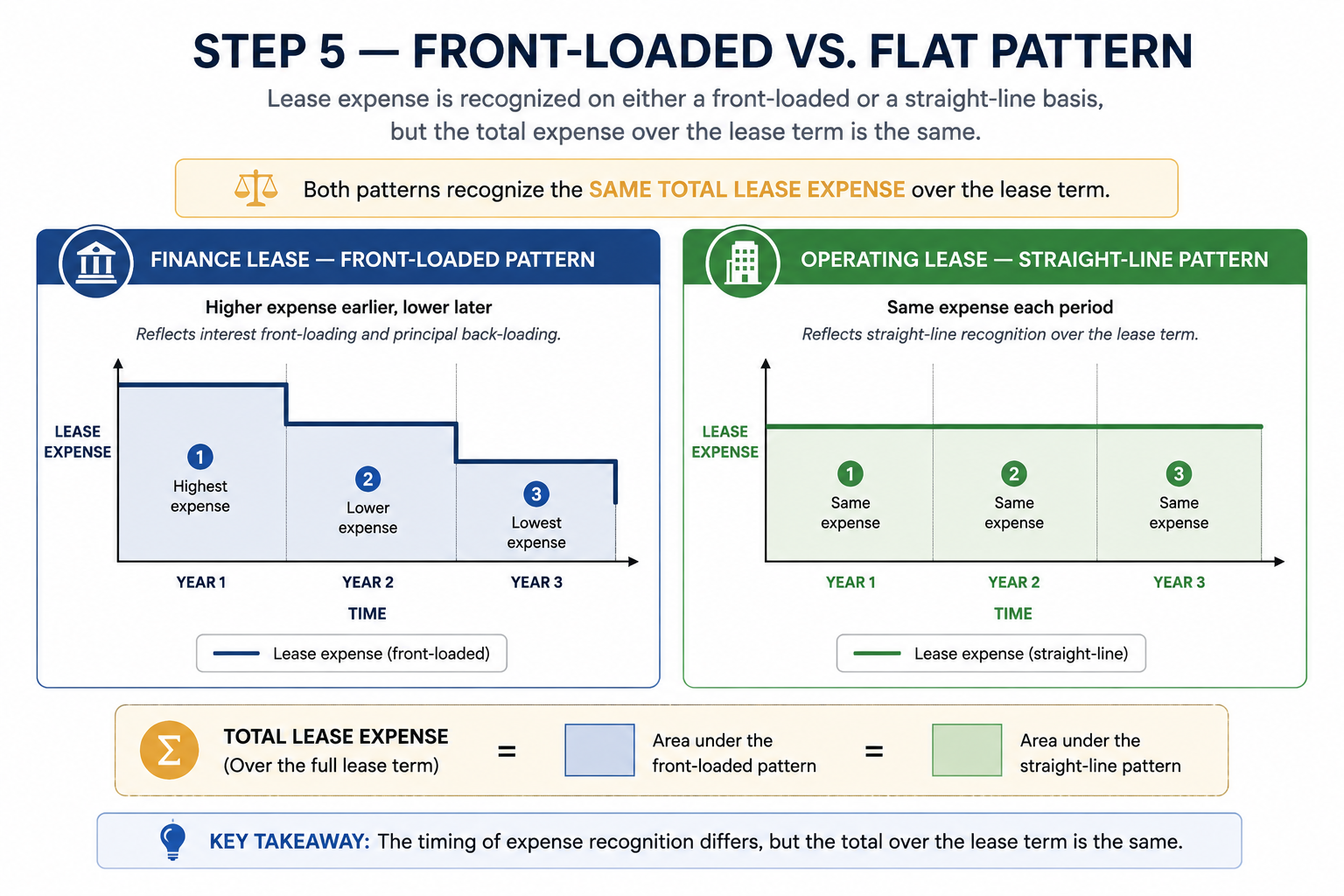
Once the liability and ROU asset are established, the balance sheet number stays the same whether the lease is classified as operating or finance. The only difference is in the P&L, the pattern in which the expense is recognized.
Worked Example base: Liability = ROU Asset = ₹10,00,000. Rate = 10%. Term = 3 years. Fixed annual payment = ₹4,02,115 (chosen so the balance reaches exactly zero by the end of year 3).
Liability Amortization Table (this table is identical for both operating and finance leases):
| Year | Opening Balance | Interest @10% | Payment | Principal Repaid | Closing Balance |
|---|---|---|---|---|---|
| 1 | 10,00,000 | 1,00,000 | 4,02,115 | 3,02,115 | 6,97,885 |
| 2 | 6,97,885 | 69,789 | 4,02,115 | 3,32,326 | 3,65,559 |
| 3 | 3,65,559 | 36,556 | 4,02,115 | 3,65,559 | 0 |
Interest declines every year, the smaller the remaining balance, the smaller the interest (exactly like a home loan EMI).
⚠️ Common mistake
Assuming interest increases over time (low at first, then rising). It's the opposite, interest is highest in year 1, because the full balance is still outstanding at that point.
Finance Lease P&L (Interest + straight-line ROU depreciation, ₹10,00,000 ÷ 3 = ₹3,33,333/year):
| Year | Interest | Depreciation | Total Expense |
|---|---|---|---|
| 1 | 1,00,000 | 3,33,333 | 4,33,333 |
| 2 | 69,789 | 3,33,333 | 4,03,122 |
| 3 | 36,556 | 3,33,334 | 3,69,890 |
| Total | 2,06,345 | 10,00,000 | 12,06,345 |
The pattern is front-loaded, higher expense early on, lower later.
Operating Lease P&L (Total cash ÷ number of years, no interest table needed):
Total cash = ₹4,02,115 × 3 = ₹12,06,345. Equal share per year = ₹4,02,115 (flat, identical across all three years).
The key point: both approaches arrive at the same total (₹12,06,345). Only the timing differs. The total cost of the lease doesn't change by a single rupee.
Classification test, which bucket a lease falls into:
- Does ownership transfer at the end of the lease?
- Is there a bargain purchase option (so cheap that not exercising it would be irrational)?
- What proportion of the asset's useful life does the lease term cover?
- How close is the PV of payments to the asset's full fair value?
If even one of these is strongly "yes," it's a finance lease.
Example: A machine with a 10-year useful life, leased for 9 years (= 90% of useful life), with the PV of payments equal to 95% of fair value. Both signals are very high → finance lease.
Step 6
Lessor Accounting
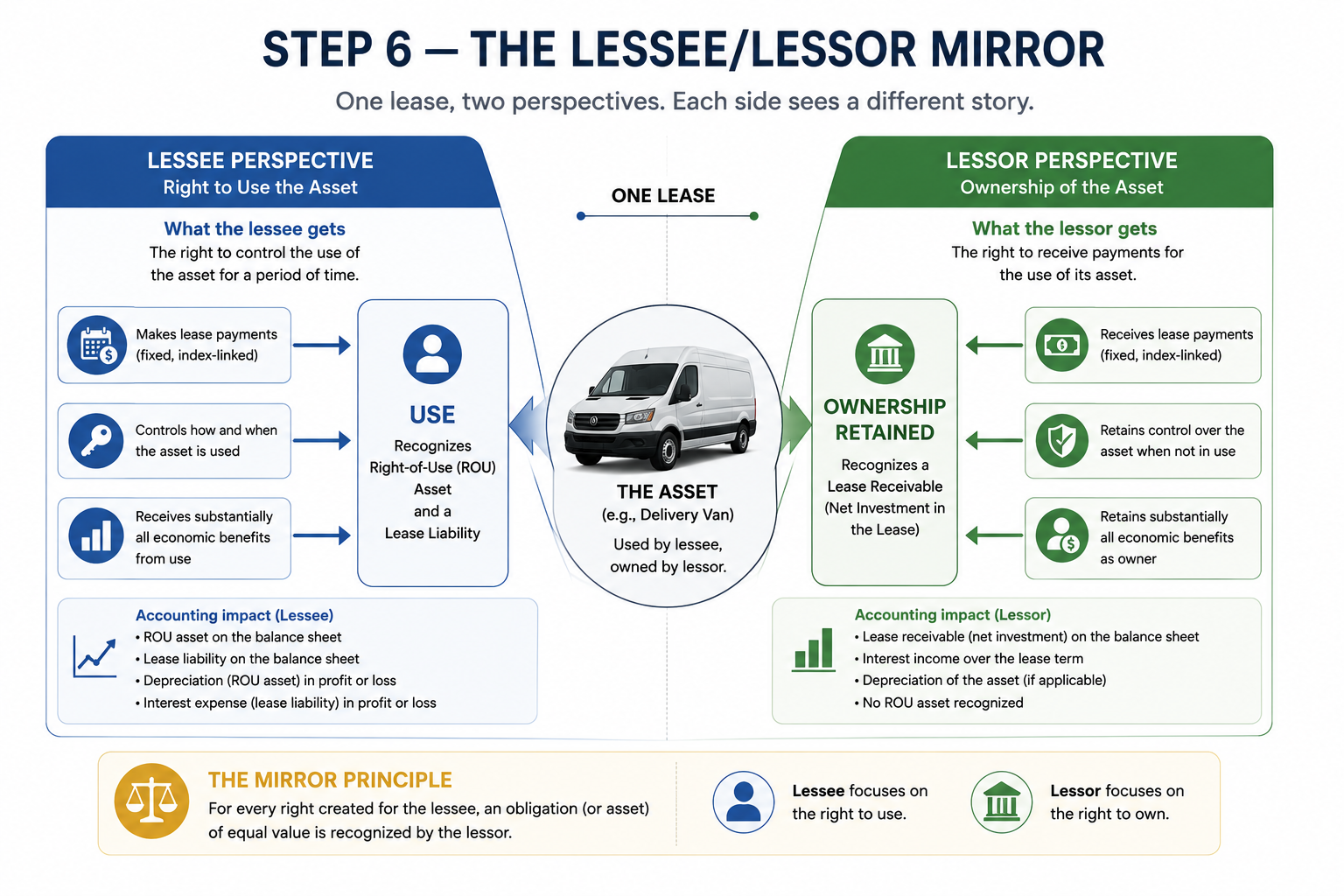
This is the other side of the same transaction, the company providing the asset. Interestingly, the same classification test (useful-life percentage, PV/value percentage) applies here too, just from the reverse perspective.
Continuing the machine example (10-year life, 9-year lease, PV at 95% of fair value, already classified as "finance-type" from the lessee's side).
Assume: the machine's fair value at commencement is ₹20,00,000. The lessor's own carrying cost is ₹18,00,000 (there's a dealer margin, this makes it a sales-type lease; if carrying cost equalled fair value, with no margin, it would instead be called a direct financing lease, though the mechanics are very similar).
Sales-type / Direct Financing Lease (lessor's side):
- The machine is derecognized from fixed assets, the ₹18,00,000 comes off the books.
- A Lease Receivable is recognized, the PV of the payments to be received, roughly ₹19,00,000.
- A selling profit is recognized immediately = Fair Value − Carrying Cost = 20,00,000 − 18,00,000 = ₹2,00,000, on day one.
- In the following years, interest income accrues on the receivable, the exact same declining pattern seen in the Step 5 table, except it's now "income" rather than "expense."
Operating Lease (lessor's side), for contrast: If this same machine were leased out for just 1 year (10% of useful life), with PV also low (10% of fair value), this is clearly operating.
- The machine stays on the lessor's own books, at ₹18,00,000, with normal depreciation continuing (say ₹1,80,000/year, straight-line).
- Only rental income is recognized each year (say ₹2,00,000 for that year).
- There's no upfront profit, no receivable, no derecognition.
A point worth noting: the classification test that nearly disappeared on the lessee side under IFRS 16 (Step 5, there's no operating-lease category left for lessees) is still fully alive on the lessor side under both standards. This comes back in Step 10.
(A small technical note: lessee and lessor don't always land on the same classification, each may have different information, such as third-party residual value guarantees known only to the lessor. Usually they align, but it isn't guaranteed.)
Step 7
Short-Term Lease Treatment (and the Low-Value Exemption)
Short-term lease: If the lease term is 12 months or less at commencement, AND there's no purchase option the company is reasonably certain to exercise, the company may choose to skip the entire ROU asset/liability process. Instead, rent is simply expensed on a straight-line basis.
Both conditions are required together, being 12 months or less is not, by itself, enough.
Example, qualifies: A generator leased for 8 months, with no purchase option. The short-term exemption applies, ROU/liability can be skipped.
Example, disqualifies: The same generator, same 8 months, but the contract now says: "after 8 months, the company may purchase the generator for ₹1,000," while its market value is ₹80,000. This is such an obvious bargain that the company will certainly exercise it, the "reasonably certain" test is met. So the short-term exemption no longer applies, even though the lease itself runs only 8 months. The full ROU asset/liability must be recognized.
⚠️ Common mistake
Assuming the exemption applies just because the term is under 12 months. The purchase option must be checked as well.
Low-value asset exemption, IFRS 16 only: If the underlying asset is low in value when new (a commonly cited illustrative threshold is around USD $5,000, this isn't a hard rule written into the standard itself, but it's the benchmark generally used in practice), the lessee may skip ROU/liability regardless of how large the company is, and regardless of whether the amount would be material to them.
Example: A company leases 50 laptops for its office, at ₹40,000 each. This is comfortably below the threshold, the low-value exemption can be applied, with straight-line expensing.
Difference between short-term and low-value: The short-term election is made by class of underlying asset (e.g., "all vehicles"). The low-value election is made lease by lease (each individual lease assessed separately).
The first genuine divergence: ASC 842 has no low-value exemption at all. Under US GAAP, no matter how small the asset, if the lease isn't short-term, the ROU asset and liability must be recognized.
Step 8
Lease Modifications
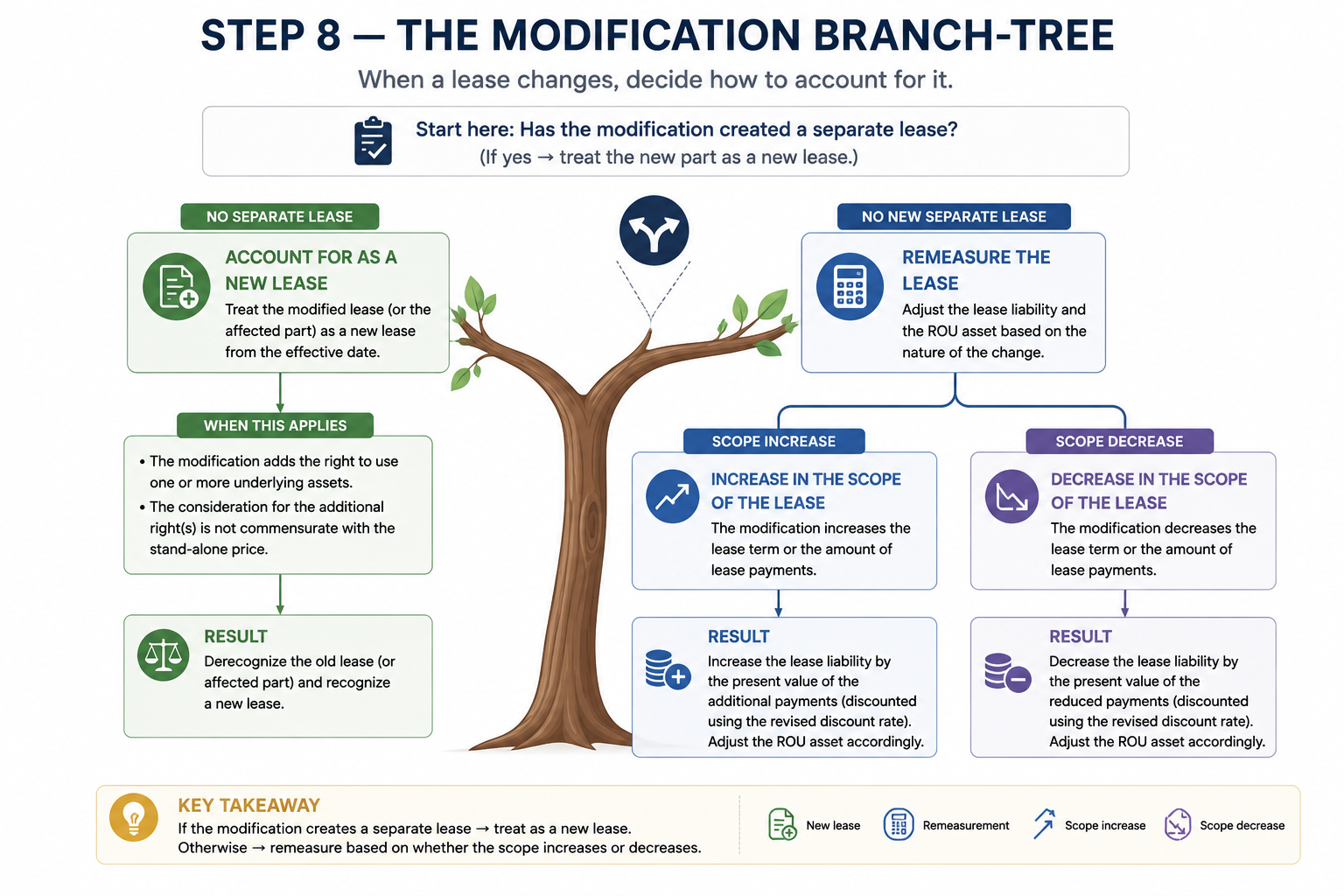
A modification is a change to the scope or consideration of a lease that wasn't part of the original terms (extending the term, adding or removing assets, changing the payment amount).
Two paths (a fork):
Fork 1, a new, separate lease: If the modification grants additional scope (more assets or space) at a price that is in line with the standalone price for that addition (a fair price, not a giveaway), it's treated as an entirely new, separate lease. The original lease continues exactly as before.
Fork 2, remeasure the existing lease: Everything else (extending the term without a proportionate price increase, reducing scope, changing payment terms) requires remeasuring the existing liability and ROU asset, using a revised discount rate.
- When scope increases or the term is extended: the liability and ROU asset are both adjusted by the same amount. No gain or loss hits the P&L, only future amortization changes.
- When scope decreases (partial termination): the ROU asset is reduced proportionally (by the same percentage as the scope reduction). The liability is recalculated to its new PV. The difference between these two, a gain or a loss, goes straight to the P&L.
Worked Example, Partial Termination: A company has a fleet lease covering 10 vans. The liability currently stands at ₹50,00,000, and the ROU asset at ₹45,00,000 (some amortization has already occurred). The company returns 4 of the 10 vans (a 40% reduction in scope).
- Proportional ROU write-down = 40% × 45,00,000 = ₹18,00,000 → New ROU Asset = 45,00,000 − 18,00,000 = ₹27,00,000
- New liability (for the remaining 6 vans' future payments, at a revised rate) = say ₹29,00,000 → Reduction in liability = 50,00,000 − 29,00,000 = ₹21,00,000
- Gain/Loss = Reduction in liability − Proportional ROU reduction = 21,00,000 − 18,00,000 = ₹3,00,000 GAIN, recognized immediately in the P&L.
Worked Example, New Lease: Later, the company adds 3 more vans to the fleet, at the current market rate. This becomes an entirely separate, new lease from the original (now 6-van) lease, the original lease remains untouched.
Step 9
Sale-and-Leaseback
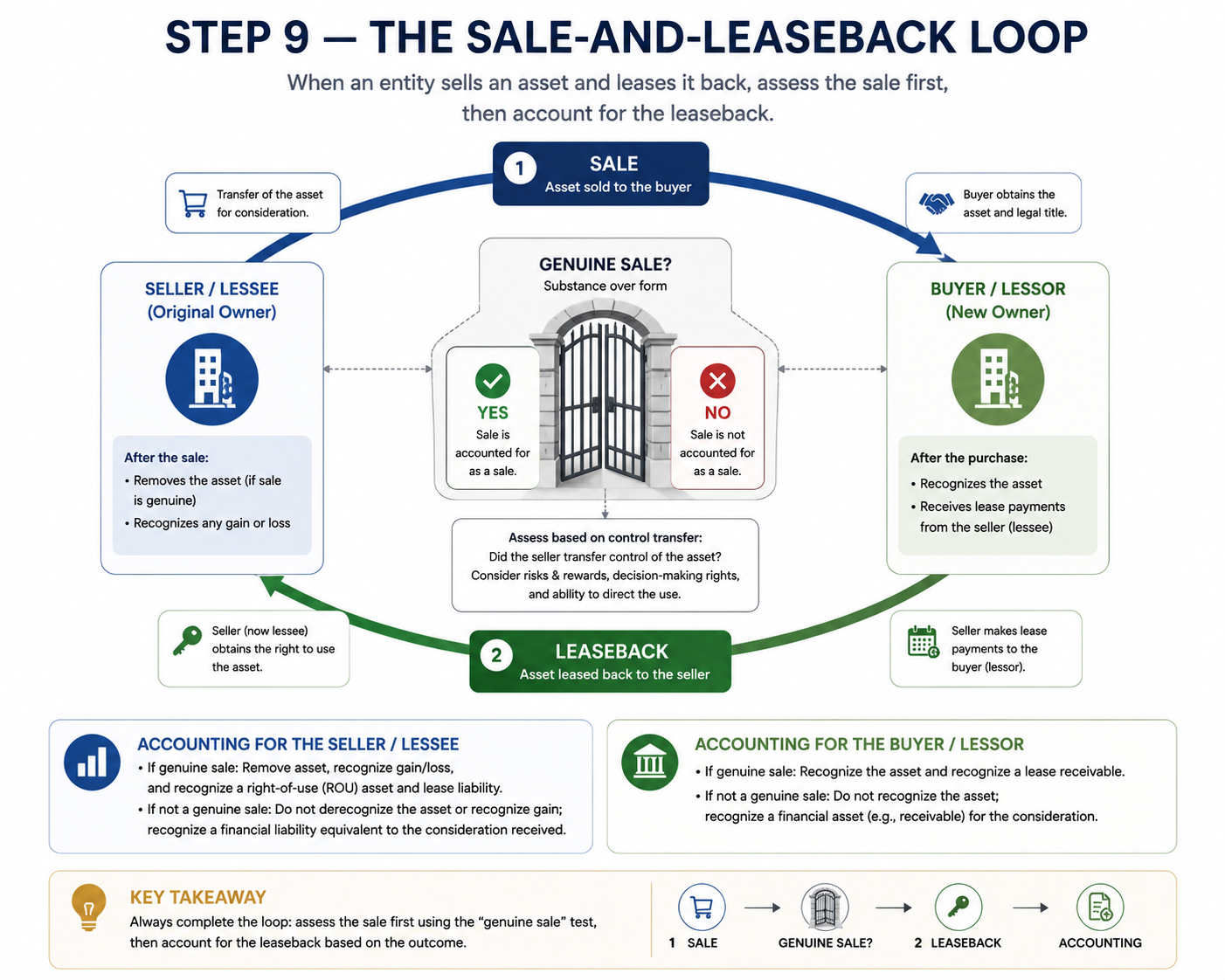
This occurs when a company sells an asset it owns, and immediately leases that same asset back.
The central question: is this genuinely a sale, based on the control-transfer test from ASC 606 / IFRS 15? (The same test that determines when revenue is recognized applies here as well.)
If it is a genuine sale (control genuinely transfers, with no problematic repurchase option):
- The seller-lessee derecognizes the asset from its books.
- The full gain is not recognized immediately, only the portion relating to what was permanently given up (transferred to the buyer). The portion relating to the rights retained through the leaseback isn't recognized as gain yet, instead, it's reflected in a smaller ROU asset for that retained right. (This is a simplified version of the mechanism, the actual formula is more precise, based on the proportion of rights retained, but this captures the underlying logic.)
If it is not a genuine sale (for example, the seller holds a fixed-price repurchase option that prevents control from truly transferring):
- The entire transaction becomes a financing arrangement.
- The asset remains on the seller's books (no derecognition).
- The cash received becomes a financial liability (akin to a loan).
- No gain is recognized.
Worked Example: A company sells its office building, book value ₹40 crore, sale price ₹60 crore (fair value), and leases it back for 15 years.
Version A, Genuine sale: No repurchase option. Total gain = 60 crore − 40 crore = ₹20 crore. Suppose the rights retained through the leaseback represent 25% of the asset's value. Then only 75% of the gain (= ₹15 crore) is recognized immediately; the remaining 25% (₹5 crore) is reflected in the ROU asset's measurement, not as gain.
Version B, Not a genuine sale: Same building, but the contract includes a clause letting the seller repurchase the building after 5 years at a fixed price of ₹65 crore (a price that could be well below future fair value, meaning the seller never really gave up control). This becomes a financing arrangement: the building stays on the seller's books at ₹40 crore, the ₹60 crore received becomes a loan-like liability, and no gain is recognized.
Step 10
ASC 842 vs IFRS 16, Divergence Hunt
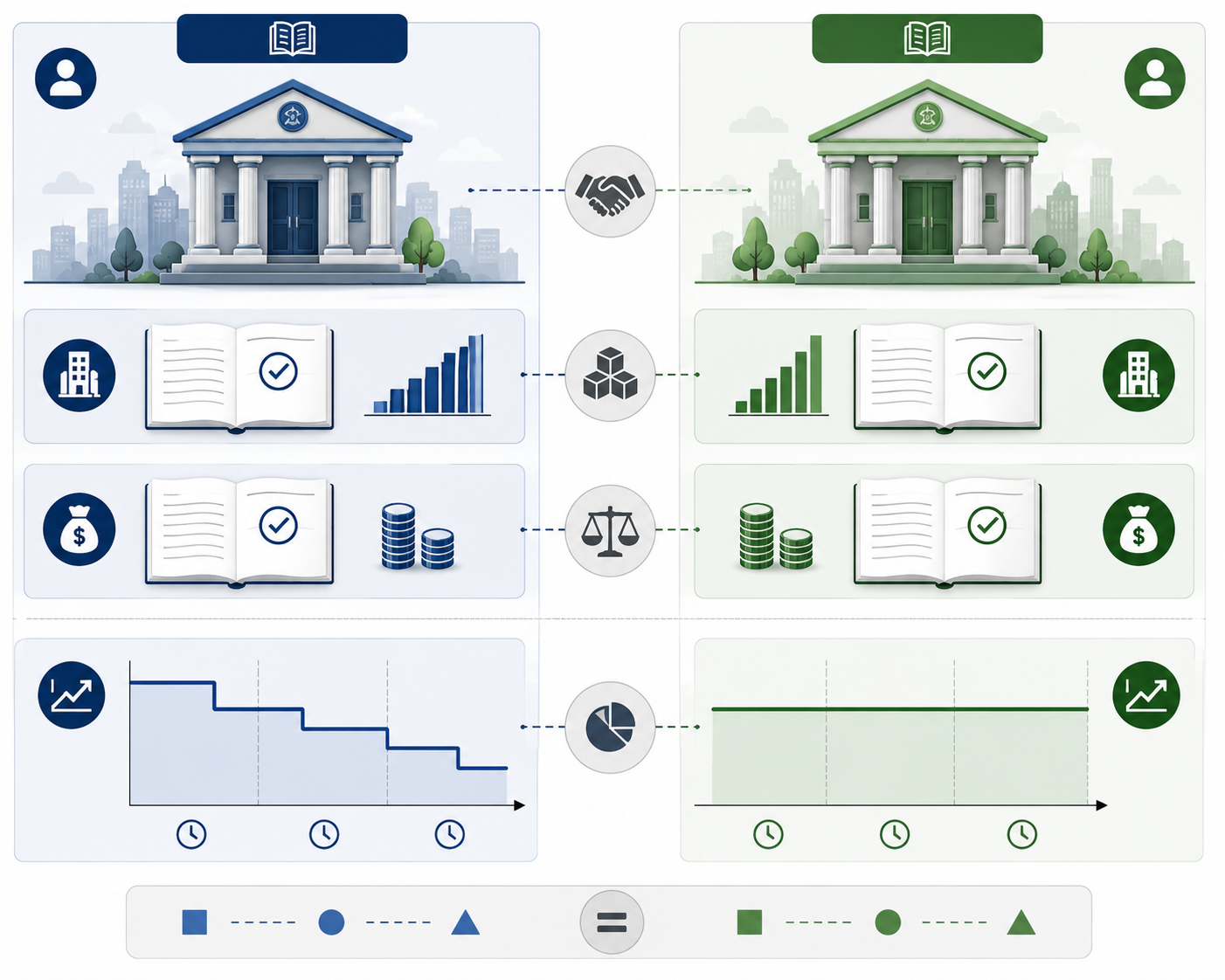
| Area | ASC 842 (US GAAP) | IFRS 16 |
|---|---|---|
| Lessee classification | Dual model, operating and finance, both on the balance sheet, different P&L patterns | Single model, nearly all leases are treated like finance leases for lessees |
| Low-value asset exemption | Not available | Available (elected lease by lease) |
| Lessor accounting | Dual classification retained (sales-type/direct financing vs operating), largely unchanged from before | Dual classification retained (finance vs operating), essentially unchanged from IAS 17 |
| Sale-and-leaseback | Same core mechanism, built on the control-transfer test in ASC 606 | Same core mechanism, built on the control-transfer test in IFRS 15 |
| Discount rate (private/non-listed lessees) | A practical expedient is available, a risk-free rate may be used, elected by class of underlying asset | No equivalent election exists |
| ROU asset impairment framework | ASC 360, a two-step model (an undiscounted recoverability test, then fair value) | IAS 36, a one-step model (the higher of value-in-use or fair value less costs to sell) |
Why these divergences exist, not just a list, but the reasoning behind it:
The entire reform arrived in 2016 because off-balance-sheet leases had become a genuinely large problem, the SEC's own estimate put US companies' off-balance-sheet lease commitments at over $1 trillion, none of it visible on any balance sheet. This was specifically a lessee-side problem, companies were concealing their obligations. There was no comparable hidden-liability problem on the lessor side (lessors were already reflecting their receivables and assets reasonably under existing rules). This is why the reform was lessee-focused, and why lessor accounting remained almost untouched in both standards.
Why lessee classification diverged: This reflects a genuine difference in philosophy. US stakeholders (particularly real estate and retail, which carry enormous lease books) pushed during the joint project to retain a dual-bucket model, preserving continuity with legacy GAAP concepts. The FASB compromised, get everything onto the balance sheet (the primary goal), but let the P&L keep two buckets. The IASB felt that multiple lessee categories only added complexity without adding decision-useful information, and pushed the single model through instead.
Why the low-value exemption exists only under IFRS: IFRS 16's single model applies to every lease, there's no natural "small leases become simple automatically" dual-bucket structure to lean on. A specific low-value carve-out was therefore necessary, or even something as small as a leased laptop would demand the full ROU/liability process. ASC 842's retained operating-lease bucket (in theory) reduced this need, even though operating leases still hit the balance sheet, their simpler P&L treatment was judged sufficient by the FASB.
Synthesis
The One Question Underneath All Ten Steps
The whole curriculum keeps returning to one question, seen from a different angle each time: who controls what, and at what point in time. Identification asks whether something exists at all (control today). The liability asks what the future cost of that control is. The ROU asset asks what that control is worth. Discount rate and term ask how that number changes over time. Classification asks whether substance matters more than form. Modifications ask what happens when control itself changes. Sale-and-leaseback asks whether control genuinely transferred, or only did so on paper.
The divergences show that even two respected regulators don't agree on exactly what "faithful representation" means, both set out to solve the same problem, off-balance-sheet leases, and chose different distances to travel in solving it.
Written by Souvik Banerjee, RTR Financial Analyst. If you'd like to see this thinking applied to a real company, try the DCF tool or get in touch.