Why India Looks Like It Chose Netflix Over Novels, And Almost Nobody Actually Made That Choice
2026-10-03
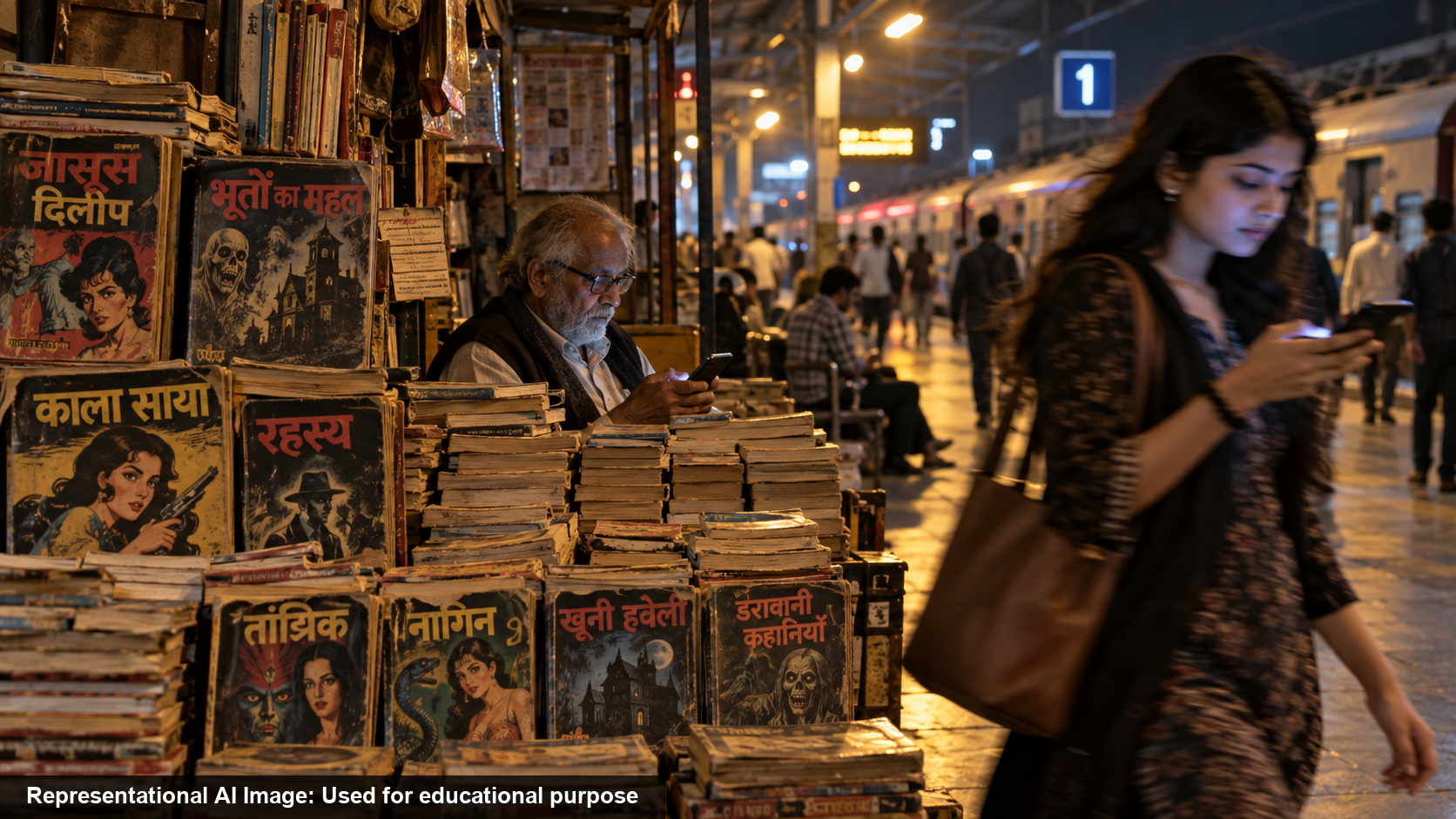
There is a bookstall on the platform of the station nearest my house that still sells Hindi pulp fiction, slim paperbacks with lurid covers, ghosts and detectives and spies, stacked the way they must have been stacked thirty years ago. I have never once seen anyone buy one. I have seen the man who runs it on his phone far more often than I have seen him make change. It is easy to read that stall as a small, sad piece of evidence for a story everyone already believes: India stopped reading, and Netflix is why.
That story has a shape to it, and the shape is simple enough to feel obviously true. A country that used to read now watches instead. Attention that used to go into a two-hundred-page novel now goes into a ten-episode season. The bookstall empties out because the phone fills up. Ask around and most people will tell you some version of this without needing to be convinced of it first. The trouble is that almost none of the specific nouns in that sentence survive contact with the actual numbers, starting with the first one.
Start with Netflix itself, since it is doing a lot of work in that sentence as the villain. Depending on which industry estimate you trust, and industry estimates on this disagree with each other more than they agree, Netflix is somewhere between a minor and a middling player in Indian streaming, not the dominant one. One widely cited brokerage report puts YouTube at over seven hundred million monthly users in India and JioHotstar at roughly four hundred million, with Netflix trailing at under a hundred million. Another report, measuring paying subscribers specifically rather than casual users, has JioHotstar at around three hundred million paid subscriptions against Netflix's twenty million, roughly fifteen times the gap. A third, tracking a narrower slice of viewer interest rather than raw subscriber counts, shows Netflix briefly closing in on Amazon Prime Video for the number-two spot in early 2026. All three can be true at once, because they are measuring different things, but none of them puts Netflix where the popular sentence puts it. "Netflix" in that sentence is not really describing a platform. It is doing the job a brand name does when it has outgrown its own product, the way "Xerox" once stood in for every photocopier regardless of who made it. The country did not choose Netflix. It mostly chose YouTube, and it chose JioHotstar, which came bundled into a mobile plan a huge number of people were already paying for anyway, and which most people experienced as something closer to free than a subscription.
Which reframes the question rather than answering it. If it is not really Netflix, it is screens in general. So did reading actually lose to screens, the way the bookstall seems to suggest?
Not by the numbers that measure the book industry itself. India's publishing market is not shrinking, it is one of the faster-growing book markets in the world right now, projected by the Federation of Indian Publishers and NielsenIQ BookData to reach roughly two lakh crore rupees by 2030-31, with the print segment growing at something close to eleven percent a year. Read only that far and the stall starts to look like an outlier, not a symptom. But break down what that growth is actually made of, and the picture changes again: educational publishing alone accounts for over a third of the market by category, and the school sector, textbooks, guides, exam preparation, makes up something like seventy percent of everything physically printed. India's reading, by volume, is overwhelmingly reading that is assigned, not chosen. A country can be printing more books than ever and still be a country where almost nobody is buying a novel for pleasure, because those are not competing for the same shelf.
Narrow the question to the specific thing it was actually about, not books in general, but the kind of reading the bookstall used to sell and a best-seller list is built on, reading done because you want to, not because an exam requires it, and there is a real, measured decline, small enough to be easy to miss and large enough to matter. The government's own Time Use Survey, analysed by economists at NCAER, found that the share of Indians who reported any leisure reading on a given day fell from about five and a half percent in 2019 to about four percent in 2024. That is not a country abandoning reading. It was never more than one person in twenty to begin with. It is a small, specific reading public shrinking further from an already small base, which is a different and frankly less dramatic story than the one everyone tells.
It is also, it turns out, an old story wearing a new villain. The idea that India once had a large, thriving mass-reading culture that streaming came along and killed gets the timeline backwards by about a quarter century. Hindi and Urdu pulp fiction, detective thrillers mostly, built on the model Ibne Safi set in the 1950s and carried forward by a generation of writers through the 1980s, really was mass entertainment once, sold cheaply enough to be genuinely disposable, read by people who would never have called themselves readers. By one well-documented trade account, its readership started thinning when satellite television arrived in 1992; a separate academic study of the genre places the decline in print sales specifically closer to the turn of the millennium, tying it to the spread of mobile phones and the early internet. Either timeline puts the real damage at least fifteen years before Netflix had so much as an India office, let alone an India subscriber base, in 2016. Blaming streaming for killing that reading culture is a bit like blaming a traffic jam on the car that joined the highway after everyone else was already stuck.
So what actually did happen around 2016, if it was not Netflix arriving? The honest answer is less a story about content than a story about plumbing. Reliance Jio launched in September that year and, within about a year, cut the price of a gigabyte of mobile data by something close to ninety to ninety-five percent, from somewhere around two to three hundred rupees down to the low tens of rupees. Monthly data consumption nationally went from roughly two hundred million gigabytes to over a billion within six months of launch, and video was the single biggest thing driving that number up. That is not a platform winning a content war. It is the cost of an hour of video collapsing by an order of magnitude at almost the exact moment several hundred million people were coming online for the first time in their lives.
And this is the part that actually matters for the reading question, because of who those several hundred million people mostly were not. They were not, for the most part, the pre-existing English-and-Hindi literate, urban, book-buying audience that a best-seller list is written for and about. Roughly half of rural fifth-graders in India, per the most recent ASER survey, cannot yet read a text pitched at a second-grade level, a gap that does not close itself the day someone turns eighteen and gets a smartphone. The national literacy rate sits somewhere around seventy-seven to eighty-one percent depending on whose recent estimate you use, but that figure measures whether someone can read and sign a simple sentence, which is a very different and much lower bar than sitting comfortably through three hundred pages of a novel for pleasure. For a very large share of Jio's first wave of users, the realistic choice was never a best-seller versus a show. It was a free video in a language they already spoke fluently, against a printed book in a script they read haltingly, if at all, bought with money that was not especially spare to begin with.
The cost difference alone is almost comic once you put real numbers next to it. A Netflix mobile plan in India currently runs about a hundred and fifty rupees a month. A popular paperback costs somewhere between three hundred and six hundred rupees and takes most readers several hours spread over several days to finish. Per hour of entertainment actually consumed, a month of Netflix on a phone can cost less than a tenth of what a single novel does. But even that comparison flatters Netflix specifically, which most of this new audience was not even using, the realistic comparison for most of them was a book against YouTube, which is free, or a JioHotstar plan already bundled into a phone bill they were paying regardless. Reading did not lose a fair fight to Netflix on price. It lost a wildly unfair one to video in general, and Netflix was mostly watching from the sidelines of its own supposed victory.
Here is the twist that the bookstall genuinely cannot see, though, and it is the one that changes the whole shape of the argument: a lot of that new audience did not actually stop reading. It moved somewhere the best-seller framing never thought to look. Pratilipi, a self-publishing platform for fiction in a dozen Indian languages, has at various points reported more than twenty million monthly active readers, mostly reading for free, spending somewhere around forty minutes to an hour a day on the app, figures that would count as a serious reading habit by any standard, and one that would never show up in a retail sales report or an English best-seller list, because it was never going to be sold in a bookshop to begin with. The pulp fiction tradition that supposedly died a generation ago did not actually die. One academic study of the genre describes it finding what the author calls an afterlife on the internet, the same stories, more or less the same appetite, now serialised on a phone instead of printed on cheap paper, read by people the bookstall's owner would recognise instantly if he ever saw their reading list, which he never will, because none of it passes through his stall anymore.
Which leaves one harder question still standing, and it is worth being honest about how far the India-specific explanation actually reaches: is any of this uniquely Indian, or is "people are reading less" simply a true thing happening everywhere right now, dressed up in local costume? Look at the United States, a country with none of India's language fragmentation, none of its literacy gap, and a Netflix that actually is the market leader there, and the answer gets complicated rather than clean. Pew Research's most recent survey finds that about three-quarters of American adults read at least part of a book in the past year, a share that has barely moved since 2011. Gallup, asking a different question, found American adults reading an average of twelve and a half books in 2021, the fewest Gallup has recorded since 1990. The National Endowment for the Arts, narrower still, finds that the specific habit of reading novels, stories, or poetry has been declining for decades and dropped again sharply between 2017 and 2022, down to under half of American adults. All three of those are true. None of them contradicts the others. They are simply measuring three different things, whether you read anything at all, how much you read, and whether what you read counts as literary, and each shrinks a little faster than the one before it, which is itself telling.
What is more telling still is what American researchers increasingly point to as the actual competitor for that narrowing attention, and it is not what the popular story would guess. Several recent analyses of the US decline single out short-form content, the kind of five-to-fifteen-second video that fills the gaps between everything else, as a sharper rival to sustained reading than any streaming show, on the logic that a show at least asks for the same kind of extended, settled attention a book does, while a feed of short clips is built specifically to interrupt exactly the kind of unbroken stretch reading needs. India's own Time Use Survey researchers reached almost the identical diagnosis independently, attributing the drop in Indian leisure reading less to long-form viewing than to short-form platforms colonising the small fragments of spare time in which reading for pleasure has always actually happened, for people who have never had large unbroken stretches of free time to begin with. Two countries, two languages, two completely different research teams, the same unglamorous culprit, and in both cases, it is not the thing anyone names first.
Stack all of this up and the question stops being one question. It was always at least three, wearing a single costume. There is an old story, which has almost nothing to do with streaming: a mass vernacular reading culture that television had already thinned out a full generation before anyone in India had heard of Netflix. There is a newer infrastructure story, in which an entire country's cost of accessing video collapsed by an order of magnitude at the precise moment hundreds of millions of people, who were mostly never going to be best-seller readers regardless of what else existed, came online for the first time, a story about Jio and literacy and language, with streaming services as almost incidental beneficiaries rather than causes. And there is a very recent story, barely finished happening, in which a smaller, pre-existing reading class really is reading less than it used to, not because of a show, but because of the feed sitting in the gaps between everything, which appears to be doing more or less the same thing to readers in Iowa as it is doing to readers in Indore.
I think about the bookstall differently now than I did before I checked any of this. The man running it is not wrong that nobody is buying his paperbacks. But I suspect he is looking for his old customers in the only place he has ever been able to see them, a stack of printed paper on a platform, when a fair number of them might be standing fifteen feet away from him right now, phone in hand, reading something in a language he would recognise instantly, in a story not unlike the ones he used to sell, for free, in a form his stall was never built to register as reading at all.
Notes: OTT platform reach and subscriber figures for India vary significantly depending on what exactly is being measured, monthly active users, paying subscribers, or share of viewer interest, and are drawn here from brokerage and industry estimates (CLSA, HSBC, and JustWatch) reported between 2025 and 2026; the ranking is more consistent across these than the precise numbers are. Figures on India's book publishing market, including the educational segment's share, are drawn from the India Book Market Report 2026-2030, published by the Federation of Indian Publishers in partnership with NielsenIQ BookData. Foundational reading levels among rural schoolchildren are drawn from ASER 2024, Pratham's annual household survey. Figures on the post-2016 collapse in Indian mobile data prices and the resulting surge in consumption are drawn from multiple industry and telecom reports on Reliance Jio's launch and its aftermath. The decline in Indians reporting leisure reading between 2019 and 2024, and its attribution to time scarcity and short-form video rather than long-form viewing, is drawn from NCAER's published analysis of the government's Time Use Survey. Pratilipi's readership figures are drawn from company statements and press interviews across several years and should be read as approximate rather than current to the day. US reading figures are drawn from Pew Research, Gallup, and the National Endowment for the Arts, which measure different things, any reading, volume of books read, and literary reading specifically, and are not directly comparable to each other or to the Indian figures. The history of Hindi and Urdu pulp fiction's rise and decline draws on trade journalism and academic writing on the genre. Several figures here, particularly prices, will have moved by the time this is read and should be taken as indicative of the shape of things rather than exact to the rupee.