Why Households Don't Track Their Blood Work, And Why an Insurance Form Gets It Done by Friday
2026-10-08
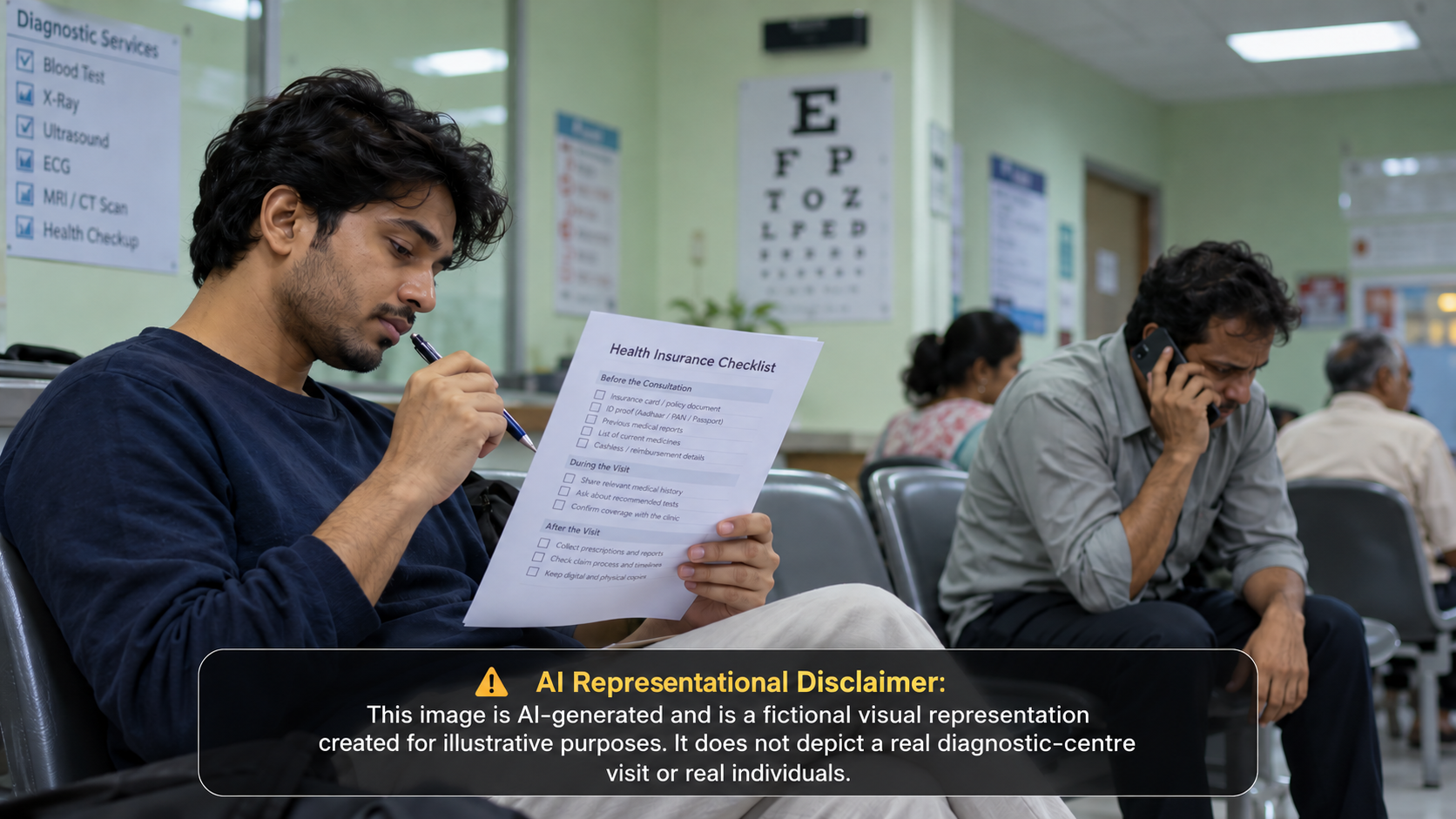
The last time I had a full blood workup done, it wasn't because I wanted to know anything. An insurance company wanted to know, before it would agree to sell me a policy. I sat in a diagnostic centre with a form listing eleven tests I hadn't asked for, and two chairs down, a woman was on the phone trying to get her father's reports expedited, because a scan the day before had found something his doctors wanted confirmed immediately. Her blood was being drawn because her father's body had already started an argument it looked to be losing. Mine was being drawn because an underwriter I would never meet wanted a number before signing anything. Neither of us was there on our own initiative. We had each simply been asked, by somebody or something that had the power to withhold what we wanted if we said no.
The easy explanation for why households don't track this on their own is that testing costs money, and a lot of Indian households don't have spare money for a problem they don't yet have. It's a reasonable first guess, and it comes apart quickly. A survey across Mumbai, Delhi and Bengaluru found that sixty-eight percent of urban adults don't practise any preventive healthcare at all, not rural India, not the poor, people in three of the country's wealthiest cities. And it isn't that they feel fine: sixty-one percent of the same respondents had already acknowledged some health issue, mostly the ordinary modern kind, joint pain, low immunity, creeping weight. A study in rural Tamil Nadu found a similar pattern from the other direction: fewer than three in ten adults had ever had a preventive checkup, and when researchers went looking for why, cost showed up, but so did something harder to put a rupee figure on.
That something came into focus in a study run in rural Andhra Pradesh, where health workers had already done the hard part for people. A door-to-door screening programme had flagged individuals at high risk for diabetes and referred them straight to a clinic for a confirmatory blood test, free of the usual friction of deciding to go yourself. Most still didn't go. The researchers logged every reason people gave: an inconvenient facility, no nearby centre, cost, a long wait. Add every one of those together and they explain a little over one in ten of the no-shows. The honest, less comfortable finding the paper landed on was that most of the gap wasn't logistics at all. It was what researchers call low risk perception, a polite way of saying that even after being personally flagged and personally referred, most people still didn't feel the thing was urgent enough to act on today.
If cost and distance aren't doing most of the work, the cleanest way to find out what is would be to find a country that removes both entirely and watch what happens. Britain already ran that experiment. Everyone between forty and seventy-four is entitled to a free NHS Health Check once every five years, a blood pressure and cholesterol screen, delivered at a local surgery, paid for by the state, with a personal invitation mailed to your door so you don't even have to remember it exists. In the most recent year on record, thirty-five percent of the people invited actually went. That's the lowest uptake in over a decade, down from forty-nine percent when the scheme first launched, with some regions sitting as low as one in nine. Cost, distance, remembering, even deciding: a programme that erased every one of those barriers still can't get a majority of its invitees through the door. Whatever is actually driving this survives being handed a free, personal, hassle-free invitation completely intact.
Which is the point where the insurance form I was sitting with starts to look less like an inconvenience and more like the actual answer. Nobody mailed me an invitation to that diagnostic centre. I was told, plainly, that a policy I wanted would not exist without that number. An employer in India hiring for anything resembling a hazardous role is legally required to run a pre-employment medical before the person starts. A term insurance applicant is, in most cases, asked to produce a blood sugar, lipid profile and complete blood count before the insurer will take the risk. The regulator even requires the insurer to pay at least half of that cost itself, so money isn't the live variable in that particular room. In every one of these cases, uptake isn't thirty-five percent. It's effectively total, because the alternative to testing isn't "I'll do it eventually." It's "I don't get the job," or "I don't get the policy." Compliance didn't require anyone to feel motivated about their health. It required someone else to make withholding something real, and due today, contingent on a number. Even where employers do try to offer this without that kind of hard edge, an annual checkup as a workplace benefit rather than a hiring condition, the gap shows up again: one large Indian workplace-health study found barely a quarter of organisations had moved past the earliest, least structured stage of managing employee health, and that employees who actually completed three straight years of the annual checkup were hospitalised at roughly a third the rate of those who never went at all. The benefit existing didn't do the work. Someone still had to make it matter.
A health crisis produces exactly the same testing behaviour, at exactly the same speed, through exactly the same mechanism. It just moves the party doing the asking. Nobody has to persuade a family rushing a parent to a diagnostic centre that early detection matters; every test the doctor orders gets done, same day, whatever it costs, because the body itself is now the one withholding something, and for the first time the cost of refusing isn't a probability attached to some unspecified future. It's sitting in the room right now. A "tragic issue," looked at this way, isn't a special, uniquely motivating category of event at all. It's simply the one asker nobody can afford to put off, because unlike an insurer or an employer, it doesn't send a form and wait for a convenient week. It just starts acting on the body regardless of whether anyone has agreed to anything.
What makes the Indian version of this sharper than Britain's is that India doesn't even have the weak middle option that still failed there. The NHS Health Check exists because Britain still runs on a general-practice model: everyone is formally registered with one surgery, which is how an invitation letter even knows to go out in the first place. India's version of that relationship, the family doctor who tracked a household across years and might plausibly have nudged somebody toward a routine test, is, by most accounts from people who study the system, fading fastest exactly where people can most afford to replace it. Urban patients increasingly walk straight into a specialist or a corporate hospital for whatever specific thing is bothering them that week, with nobody positioned to ask about anything else. So where Britain has an asker whose request simply gets ignored, large parts of India don't have a standing asker at all. There's the occasional one with real teeth: a job, a policy, a scan a doctor has already ordered. And then there's nothing, until the body itself steps in to fill the gap no institution was occupying.
Even then, the testing that does happen rarely extends past whoever is currently making the demand. A household with one member who's just had a cardiac scare will often get that one member thoroughly worked up and monitored for months, while everyone else in the same house, eating the same food, carrying some of the same genes, goes on exactly as before, because nobody with any leverage is currently asking about them. Households aren't actually refusing to test; they're arguably quite responsive once something does ask. What's missing in India is ambient asking, the kind that happens whether or not anyone is currently sick. What's left is narrow and specific, attached to one name on one form at a time, and that description fits an insurance underwriter, an HR department, or a tumour equally well, because apparently all three operate by the identical rule: they want the number, and only the number attached to the one case currently in front of them.
So the honest answer to why households don't track this on their own isn't apathy, and it isn't really affordability either, however much both genuinely contribute at the margins. It's that a blood report, for a person who currently feels fine, has no one waiting to receive it. Nothing today gets better or worse based on whether that test happens this month or never. An insurer, an employer, and a disease all solve that problem the same way: they attach a consequence to the number, due now, held by someone or something with the power to enforce it. A free invitation with nobody behind it to enforce anything, however well-intentioned, is competing against literally everything else on a person's actual Tuesday, and loses, politely, almost every time.
I never did find out what the woman at the diagnostic centre's father's test showed. I finished mine, collected a stamped form for an underwriter who would glance at it once and file it away, and went home with numbers I hadn't particularly wanted and wouldn't have gone looking for on my own. It occurred to me on the way out that the only real difference between the two of us that afternoon was which kind of asker had gotten there first: hers from inside the body, mine from outside it. Most years of most lives simply pass with neither one showing up at all, which is less a decision anybody makes than the plain result of nobody, and nothing, ever actually asking.
Notes: Figures on urban Indian preventive-healthcare practice and acknowledged health issues are drawn from a wellness-trends survey of adults in Mumbai, Delhi and Bengaluru. The rural Tamil Nadu figure on preventive-checkup uptake is from a 2024 study published in Cureus covering Perambalur district. The breakdown of reasons for not completing a confirmatory diabetes test after a positive screen is drawn from a population-based study in rural Andhra Pradesh, published in Global Health Action, conducted under the UDAY diabetes and hypertension programme. NHS Health Check uptake figures are drawn from Department for Health Improvement and Disparities data as reported by Broadstone and other industry analysis, alongside a nationally representative general-practice study published in the British Journal of General Practice; uptake varies by year and region and has generally trended downward since the scheme's 2013/14 baseline. Details on mandatory pre-employment medical examinations in India are drawn from labour-law reporting on the Occupational Safety, Health and Working Conditions Code and related legislation. Pre-policy medical checkup practices and IRDAI's cost-sharing rule are drawn from multiple Indian health-insurance industry sources; exact requirements vary by insurer and policy type. The workplace annual-checkup and hospitalisation figures are drawn from the CII-MediBuddy Workplace Health Report. Reporting on the decline of the family-doctor model in urban India is drawn from recent healthcare-sector journalism and a 2023 Lancet Regional Health-Southeast Asia commentary on India's primary-care gaps. All figures should be read as indicative of a pattern rather than precise, unchanging national constants, since healthcare-access data shifts with policy, region and survey methodology.